World's Largest Biceps Claimed by Moustafa Ismail

An Egyptian bodybuilder with the world's largest arms has told of the challenges that come with his 31-inch biceps, including finding a shirt and dealing with accusations of implants and oil injections.
Moustafa Ismail, also known as 'Big Mo', lives in Massachusetts. Despite not liking Popeye's staple food, spinach, he told AP: "My friends, they call me popeye, Egyptian popeye."


The 24-year-old will appear in the Guinness Book of Records for his record-breaking biceps. However since he first went public with his impressive 'guns', there has been speculation that his massive bulk was down to unnatural means.

This is an allegation Ismail vehemently denies. He tells AP: "I did an ultrasound test, a bloodtest, I did an X ray which proves I have nothing unnatural."
His arms are a result of 10 years of body building and trains at least twice a day. Take a look at some more pictures below.

Easy Exercise For Bigger Arms


Arms are one of the most functional muscles of the human body involved in all kinds of pushing / pulling movements. They are also very aesthetically appealing. Because of their high aesthetic appeal (especially for men) they have become one of the most favourite body parts to be trained. Due to this over enthusiasm of training arms, fitness enthusiasts most of the time end up over doing arm workouts.

The arm group of muscles apart from being small is also immensely involved in all torso movements. All chest and shoulder pressing movements, subject triceps to a huge overload. Similarly all Lattissimus dorsi movements, which constitute all pulling action, subject the biceps brachii, brachioradiallis and the brachialis to a huge overload.

Also the flexors and extensors of the forearm get really punished as your grip is challenged to the maximum in trying to hold on to weights good enough to challenge the strong muscles of the Lattissimus dorsi, Trapezius & Erector Spinae.

Thus we can see any kind of overdoing arm work could result in serious overtraining of arms which in turn would adversely affect their growth. As maximization of hypertrophy could only be possible in the absence of any kind of over training. Hence especially when it comes to arm training deprioritizing arm work by giving it less direct sets would work in its favor and actually lead to better development.

Exercises For The Elbow Flexors:
On the anterior of the arm lay the muscles responsible for elbow flexion

The Biceps Brachii – As the name suggests has 2 heads namely inner short head and outer long head. It is a Bi-articulate muscle in that it crosses the shoulder joint originating from the scapulae & inserts into the radius bone of the forearm by crossing the elbow joint.
Function: At the shoulder joint it assists the deltoid mildly in shoulder flexion. Lifting the arm forward like in a frontal raise. At the elbow joint it is the prime flexor & also is responsible for supination (Getting the palm to face up) of the forearm. It is capable of this supination  because it inserts into the Radius & thus can twist the radius around the ulna at the radio-ulnar joint.

Brachialis – lies underneath the Biceps Brachii originating from the middle of the humerus (Upper arm bone) & inserting on the ulna bone of the forearm.
Function: Since it inserts into the Ulna bone across the elbow joint it cannot supinate &  is only responsible for flexion along with the Biceps Brachii. Every time that the biceps brachii works on flexion, the brachiallis is sure to work with it .

Brachioradialis – It is the muscle that is visible on the elbow as the highest prominence of the forearm on the top frontal aspect of the elbow. It actually originates on the humerus very close to the elbow & traverses all the way down the forearm & inserts at the wrist on the radius bone of the forearm.
Function: Since its insertion is on the radius. It like the Biceps Brachii can flex the elbow as well as contribute to supination.

All the above 3 muscles form the elbow flexors. These muscles are extremely functional as without them, pulling in upper body movements would not be possible. Selection of exercise for elbow flexors should be based on the following

1. Exercise schedule must be kinesiologically comprehensive i.e. include movements for both the  functions mentioned above (Flexion & supination).

2. Since curling movements are circular in nature machines should be preferred over free weights  for continuous tension. If free weights are used then try using angles to give maximum effective  range in the line of gravity.

3.  Exercises should give iso-lateral advantage, which is got by usage of dumbbells over barbells. Ignoring this may lead to asymmetrical development.

4. Shoulder flexion during Biceps movements should be avoided as the Biceps brahii will get slightly involved at the shoulder & be partially insufficient at the elbow. (If you did not understand this, then please refer to my blogon the Active insufficiency theory of Bi-Articulate muscles.) This is the reason why you will not find the Preacher curl as a preferred exercise in K11 programming. The preacher bench forces the shoulder to be in flexion & thus causing a small degree of active insufficiency at the elbow joint while curling.
Considering the above points K11 recommends the following Biceps Brachii exercises.

Incline Dumbbell Curl
Type – isolation, isolateral
Joint action – elbow flexion, supination
Muscles involved – Biceps Brachii, Brachialis and Brachioradialis

This, is the best exercise for the Biceps Brachii & no other movement is needed considering the small volume of sets that are appropriate for a muscle the size of the biceps. 2 sets to failure of this one exercise in a 6-8 rep max range is enough to toast this tiny muscle.The reasons for it being the best option are:
It offers resistance to both the functions of the Biceps Brachii namely flexion and supination. Being a dumbbell movement, it offers the isolateral advantage. When done on an incline bench at a 45 degree angle the line of movement stays in the line of gravity through most of the range of motion, thus providing maximum continuous tension out of all the free weight curling exercises. The incline also ensures complete absence of flexion at the shoulder, thus eliminating any possibility of the slightest of active insufficiency at the elbow.

Execution
1. Sit on an incline bench set at a 45 degree angle with dumbbells in each hand held in hammer position. Shoulders slightly hyper extended.
2. Without moving at shoulders curl the weight up flexing and supinating simultaneously.
3. Lower in a similar fashion under control.
4. Exhale on the way up and inhale on the way down.

Brachialis (Elbow flexion)
When flexion is achieved at the elbow using a prone grip or semi prone grip (hammer) biceps brachii is deactivated to a large extent and Brachialis and Brachioradialis will get activated more.

Exercise for Brachialis
Prone grip cable curls / Reverse cable curls
Type – isolation, bilateral
Joint action – elbow flexion
Muscles involved – Brachialis and Brachioradialis

Execution
1. Set pulley at bottom most position.
2. Attach a bar handle.
3. Grip the handle using a prone shoulder width grip and execute a strict curl.
Exhale on the way up and inhale on the way down.

Note
Exercise for Brachialis will also work Brachioradialis. But the Brachioradialis will work more towards flexion if a hammer grip is used in a curl.
So Hammer curls with dumbbells will be a Brachioradialis movement & the reverse pronated curl will be a Brachialis movement.
Brachialis lies beneath biceps brachii. Significant hypertrophy of brachialis could result in increase in overall height of biceps brachii known as the bicep peak. Hence if ever a movement could be called as the best peaking exercise for biceps it would be the Reverse curl.
If ever one uses a bar to curl for biceps brachii, always preferably use the straight bar to an EZ bar. The EZ curl bar grip puts the hand in-between supinated and hammer position thus reducing involvement of bicep brachii.
 
Exercises For The Triceps Brachii
The triceps are extensors at the elbow joints. They are responsible for straightening of the arm and assist in all pushing movements. As the word suggests triceps are a group of 3 heads namely; Inner long head, Middle head and lateral head. When fully developed the triceps take a horse shoe appearance.

Anatomy: The inner long head is a Bi-articulate muscle that originates from the scapulae & thus crosses the shoulder joint as well as the elbow joint. The middle & lateral heads originate on the shaft of the humerus on the posterior side & all three insert on the ulna bone of the forearm just below the elbow.

Function: Extension at the elbow joint. Exactly opposite of the Biceps Brachii.
Again a lot of women are interested in training the triceps solely from the desire to get rid off fat from the backof their upper arms. As we know that fat is not localized and belongs to the entire body, no matter where on the body it is situated.
We also know that the ability of an exercise to burn fat will depend on the surface area of damage. Hence no triceps movement will ever be an efficient fat burner. Hence the reason to train the triceps will be due to the fact that the triceps contribute a lot to pushing strength & not as a solution to flabby arms.
Men on the other hand tend to not stress the Triceps as much as the Biceps, despite the fact that it comprises 2/3rds of the arm size. This relative neglect is a big mistake in relation to aesthetics.
There are specific compound as well as isolation exercises for triceps. As in other body parts you must always emphasize more of compound than isolation, due to more work load and functionality. The best exercises for triceps as recommended by K11 are as follows.

Decline Close Grip Bench Press
Type – compound, bilateral
Joint action – elbow extension, shoulder flexion
Muscles involved – Triceps Brachii and Anterior Deltoid

Execution
1. Lie on -15* decline bench.
2. Hold bar with shoulder width prone grip. Straight up 90 degrees to the floor at arms length.
3. Lower bar under control in line of gravity to your chest, forearms staying perpendicular to the  floor.
4. Push the weight back up to full extension at elbow by moving simultaneously at elbow and shoulder.
5. Exhale on the way up and inhale on the way down.

Note
The decline angle is preferred to the flat as in the flat angle the movement is forced into a tangent. The -15* decline angle makes the bar come down in a line of action that is perpendicular to the floor.

Exercise For Ur Butt

All women want it: That shapely, sculpted, and defined butt we see in the magazine ads for cellulite cream. Closets full of skinny jeans and miniskirts have us focused more than ever on lifting, tightening, and shaping our behinds.

But what many of us really want to know is this: Is there a butt workout that can actually help us get those round, lifted, and chiseled derrieres we covet?
It depends.
"If you're a 45-year-old mother of two and you start doing glute exercises, you're not going to look like a 20-year-old woman who's never had kids," says Maryland-based fitness trainer, speaker and consultant Jonathan Ross.
Fat cells the body has deposited around the hips and thighs are less responsive than in other parts of the body, Ross explains. "Progress is still possible. It just takes a lot of i dotting and t crossing when it comes to nutrition and exercise," he says.
Realistically, say experts, you can improve the strength and shape of your butt with diet and exercise. But if you're expecting to look just like that picture in the magazine, you may be disappointed.

The Butt Workout: Six Exercises for Glutes

Aerobically, walking hills is a great butt workout. Indoors, use a 5% to 7% incline grade on your treadmill, says Michele Olson, PhD, CSCS, exercise physiologist at Auburn University in Montgomery, Ala.
Climbing stairs is another great choice for working the glutes. Find a stadium, or use a stair machine, elliptical, or arc trainer to help define the butt. For variety, dust off those inline skates and hit the pavement.
After working up a sweat aerobically, try these six butt-busting strength exercises recommended by our experts (aiming for three sets of 10 to 15 repetitions of each):


1. Squats. One of the best exercises you can do for your butt, hips, and thighs is the squat, say experts. Stand with feet parallel and shoulder-width apart. Slowly lower your hips, making sure not to let your knees go out past your toes.
Variations are endless. "I like plie squats to really work those deep rotator muscles," Olson says. To do them, stand with your feet wider than shoulder-width apart, legs turned out. When squatting, keep knees over ankles; press through the feet and squeeze the glutes as you come up to standing.


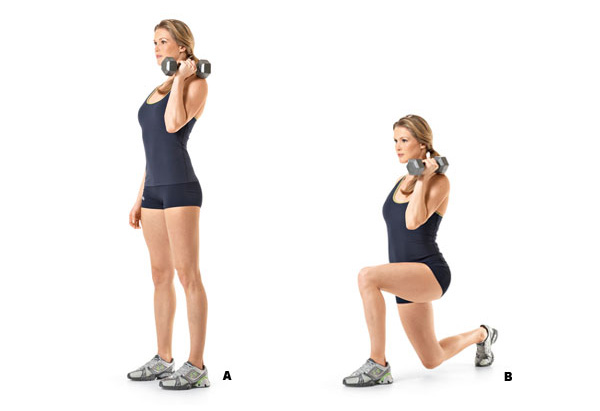
2. Lunges. Beginning with your feet parallel and hip-distance apart, take a giant step forward or backward. Slowly lower your body, bending both knees. Bend your knees no farther than 90 degrees, keeping your front knee aligned over your front ankle. Step together and repeat.
Alternate legs or do all sets on one leg and then switch for a greater challenge, says Olson: "You're cutting the rest time by half, and even though you do the same amount, your legs will be working harder."
Beginners should stay in the lunge and just lower and lift by bending the knees, she says.
Ross likes tweaking a forward lunge to really target the glutes: While lunging, reach both arms down toward the floor outside the front foot (hold a medicine ball or light dumbbell for added challenge). Durkin adds a hop to alternate feet for the advanced client.

3. Bridges. Lie on your back with knees bent and feet on the floor, hip-width apart. Slowly peel your spine off the floor from the bottom, one vertebra at a time, tightening the glutes and hamstrings (backs of the thighs) until you've created a diagonal line from your shoulders to your knees. Return to the floor slowly, one vertebra at a time.
Olson likes the one-legged bridge: Hold the knees tightly together and extend one leg at knee level while in the bridge position. Do all repetitions on one side, then switch.
To take it to the next level, try the bridge on a stability ball. With the head and tops of shoulders balanced on the ball, lift the hips into a tabletop position, level with the shoulders, then lower slightly and repeat.
Advancing from there, lift into the bridge position on the ball, then take two baby steps to your left, changing the line of gravity so you're off-center, then drop and lift the hips. "The left glute should work a bit harder than the right," Ross says. This move, he emphasizes, requires good core balance and takes only a very small shift (2-4 inches) in lower body position. Do all the repetitions on one side, then switch


.
4. Step-ups. Using a weights bench (a step would work, too), step one foot on top, then push through the top leg and glute to lift the bottom leg up and tap the bench. Lower and repeat using the same leg. Add hand weights or a knee lift with the tapping leg for a greater challenge, suggests Olson.


5. Leg/hip extensions. Reaching a leg behind your body is a great way to work the glutes. In Pilates, it's done while lying on your side, but you can also do it while lying over a stability ball or standing. Using a slow, controlled motion, extend the leg behind the body while squeezing the glutes and keeping the torso stable. Do three sets of 15 repetitions, then switch legs.
Up the ante with a single-leg dead lift, a Durkin favorite. While standing, extend one leg back and hinge from the hip. At the same time, lower the torso to parallel with the floor. Keep the abs tight and return to standing, lowering the back leg.


6. Skater plyos. Feeling like Drew Brees? Try this plyometric side step, a Durkin staple. Standing with feet under hips, take a lateral (sideways) hop to the left on your left foot while coming down to touch your right hand to the floor. Alternate sides and try to complete three sets of 20. Ouch! "This is great for strength, power, agility and toning up," says Durkin.


AT A STRETCH

Splits are not  for acrobats alone. Here"s a flexi routine to keep you pain free

Why is stretching important?

Stretching is important to help lengthen and loosen your muscles. People used to think that stretching was the first thing you should do before exercising. Now we know that you should warm up for 5-10 minutes by doing some light exercises and then you should stretch. The reason for this is that stretching cold muscles can directly contribute to pulled and torn muscles.
More information about stretching and warming up/cooling down is available here
Here are some different kinds of stretches you can do after you’ve warmed up with light exercise:


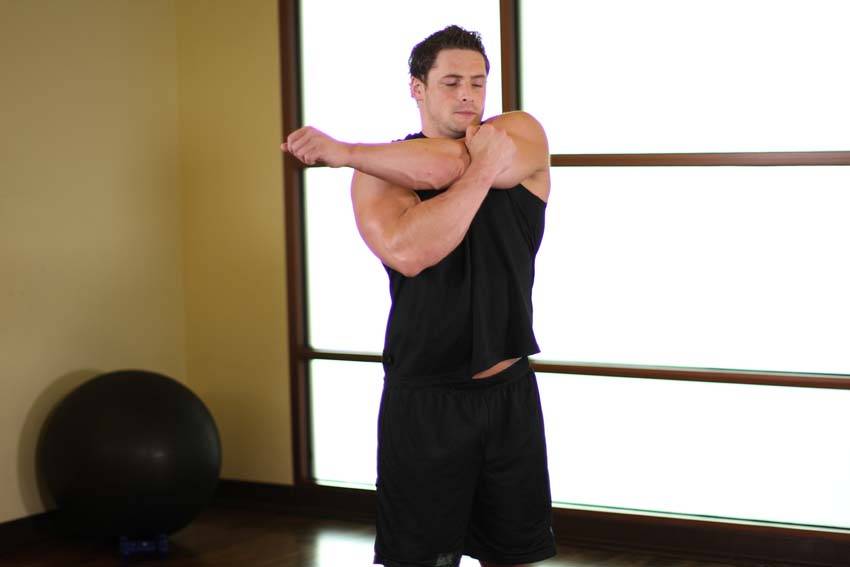
1) Cross shoulder stretch
Stand up straight, with knees slightly bent. Place feet hip distance apart. Make sure toes are pointing forward. Keep shoulders even as you complete this stretch. Bend right arm at elbow joint, extend arm across chest. Place left hand on the right elbow to gently support the arm during this stretch. Feel the stretch in your right arm and shoulder. Inhale (breathe in) through your nose, and exhale (breathe out) through your mouth, as you complete this stretch. Hold stretch for a count of 8. Repeat this stretch on opposite side, using right hand to stretch left arm and shoulder.


2) Triceps stretch
Stand up straight, with knees slightly bent. Place feet hip distance apart. Make sure toes are pointing forward. Keep shoulders even as you complete this stretch. Bend right arm at elbow joint, lift arm next to your head. Position right fingers so they touch the shoulder blade area. Place left arm across top of head, and place left hand on the right elbow to gently support the arm during this stretch. Feel the stretch in your right triceps. Inhale (breathe in) through your nose, and exhale (breathe out) through your mouth, as you complete this stretch. Hold stretch for a count of 8. Repeat this stretch on the opposite side, using right hand to stretch left triceps.


3) Chest Stretch
Stand up straight, with knees slightly bent. Place feet hip distance apart. Make sure toes are pointing forward. Keep shoulders even as you complete this stretch. Place arms behind your back. Clasp your hands together, extending your arms behind your back and hold this position. Feel the stretch in your chest. Inhale (breathe in) through your nose, and exhale (breathe out) through your mouth, as you complete this stretch. Hold stretch for a count of 8.


4) Quadriceps stretch
Stand facing a wall, about 1 foot away from it. Keep yourself up by putting your right hand against the wall. Raise your left leg behind you and grab your foot with your left hand. Pull your heel slightly up toward your bottom, stretching the muscles in the front of your left thigh for 20 seconds. Keep your thighs close together to keep your knee aligned and stretch effective. Repeat the stretch with your right leg

BICEPS EXERCISE FOR WOMEN

                  
  1. Stand up with your torso upright and a dumbbell in each hand being held at arms length. The elbows should be close to the torso.
  2. The palms of the hands should be facing your torso. This will be your starting position.
  3. While holding the upper arm stationary, curl the right weight forward while contracting the biceps as you breathe out. Continue the movement until your biceps is fully contracted and the dumbbells are at shoulder level. Hold the contracted position for a second as you squeeze the biceps. Tip: Only the forearms should move.
  4. Slowly begin to bring the dumbbells back to starting position as your breathe in.
  5. Repeat the movement with the left hand. This equals one repetition.
  6. Continue alternating in this manner for the recommended amount of repetitions.
Variations: There are many possible variations for this movement. For instance, you can perform the exercise sitting down on a bench with or without back support and you can also perform it by doing both arms at the same time.
Same as the Hammer Curl but you alternate arms.

BISEPS EXERCISE FOR MEN

                 
  1. Stand up with your torso upright and a dumbbell in each hand being held at arms length. The elbows should be close to the torso.
  2. The palms of the hands should be facing your torso. This will be your starting position.
  3. While holding the upper arm stationary, curl the right weight forward while contracting the biceps as you breathe out. Continue the movement until your biceps is fully contracted and the dumbbells are at shoulder level. Hold the contracted position for a second as you squeeze the biceps. Tip: Only the forearms should move.
  4. Slowly begin to bring the dumbbells back to starting position as your breathe in.
  5. Repeat the movement with the left hand. This equals one repetition.
  6. Continue alternating in this manner for the recommended amount of repetitions.
Variations: There are many possible variations for this movement. For instance, you can perform the exercise sitting down on a bench with or without back support and you can also perform it by doing both arms at the same time.
Same as the Hammer Curl but you alternate arms.


Club Fitness Gym © 2012 | Designed by Cheap Hair Accessories

Thanks to: Sovast Extensions Wholesale, Sovast Accessories Wholesale and Sovast Hair